EQ-Seer connects and reads your plant data, then puts your operators' intuition on top of it. Problems get caught while they're forming, and the fix that worked is there the next time they show up.
The knowledge that keeps a line running is hard to see and easy to lose.
Most plants already have the data. It just lives in systems that don't talk to each other, and the reasoning that ties it together sits with a few people who know the line by feel.
Systems that don't talk
Control systems, historians, ERP, quality, CMMS and batch records each hold a piece of the story. Nobody sees the whole run at once.
Know-how in a few heads
Two or three long-tenured people know why the line really behaves the way it does. When they take a day off, or retire, that reasoning leaves with them.
You find out too late
A small drift becomes scrap or downtime before anyone connects the readings. The post-mortem happens after the line is already stopped.
How it works
Connect everything. Learn a good run. Catch the bad one early.
One loop that gets sharper every time a problem comes back.
01 · Connect
Wire it all in
Control systems, historians, ERP, quality, CMMS, batch records and documentation come into one live picture of the line.
02 · Learn
Profile a good run
EQ-Seer builds a picture of what "good" looks like from the plant's own history — the readings that come with product that ships.
03 · Watch
Flag the drift early
Live output is compared to that profile. Equipment and process deviations surface while there's still time to act.
04 · Guide
Point to the fix
Operators and techs see the likely cause next to what has actually fixed it before on that asset.
05 · Capture
Keep what worked
The tech records the new fix at the machine — voice, video, photo or a note — tagged to the asset and symptom, marked whether it worked.
Every fix that worked feeds step 2. The answer gets more confident each time the problem returns, and it stays after the people who knew it move on.
For your team
One picture of the line that everyone trusts.
The same live truth about the plant, read the way each role needs to read it, from the machine to the boardroom.
Shopfloor Operations
See the problem before the line does.
Operators and technicians get the likely cause and the fix that worked last time, right at the machine — then capture the new fix in seconds without leaving the job.
Likely cause and past fixes surfaced for this exact asset
Capture what you did by voice, video, photo or a note
Ask in plain language and get an answer from your own plant
No hunting through binders or pinging the one person who knows
Process Engineers
Know what a good run looks like, and when it drifts.
Compare live batches against a known-good profile built from your own history, and trace every deviation back to the parameter and asset behind it.
A good-run profile learned from the plant's own history
Deviations tied to the exact parameter and asset
Signals, batch records and SOPs linked in one graph
Read-only — nothing writes back to your control systems
Maintenance Team
Get to the fix faster, and make it stick.
Technicians see the likely cause and the repairs that actually worked on that asset, then log the new fix where the work happens so the next person isn't starting from scratch.
Likely cause ranked next to repairs that worked on this asset
Work-order and asset history from your CMMS in the same view
Capture the repair by voice, video, photo or note at the machine
Fewer repeat failures and lower MTTR as the history builds
Plant & Ops Leaders
Fewer surprises, and faster recovery when they come.
Watch scrap, downtime, MTTR and repeat failures in one place, and give every shift the reasoning that lives with your two or three most experienced people today.
Scrap, downtime, MTTR and repeat failures in one view
Deviations caught early, before they become downtime
Newer operators perform closer to your veterans
Start on one line and expand as the graph compounds
Executive & Management
Turn hard-won know-how into something the plant keeps.
The expertise that usually walks out the door at retirement becomes an asset that stays: across shifts, across sites, and through every change in the crew.
Institutional knowledge retained through turnover and retirement
A repeatable way to run every plant to its best day
Reads the systems you already run — no rip-and-replace
Enterprise security, isolated per plant, deployed your way
The platform
One brain for the floor, built from your own plant.
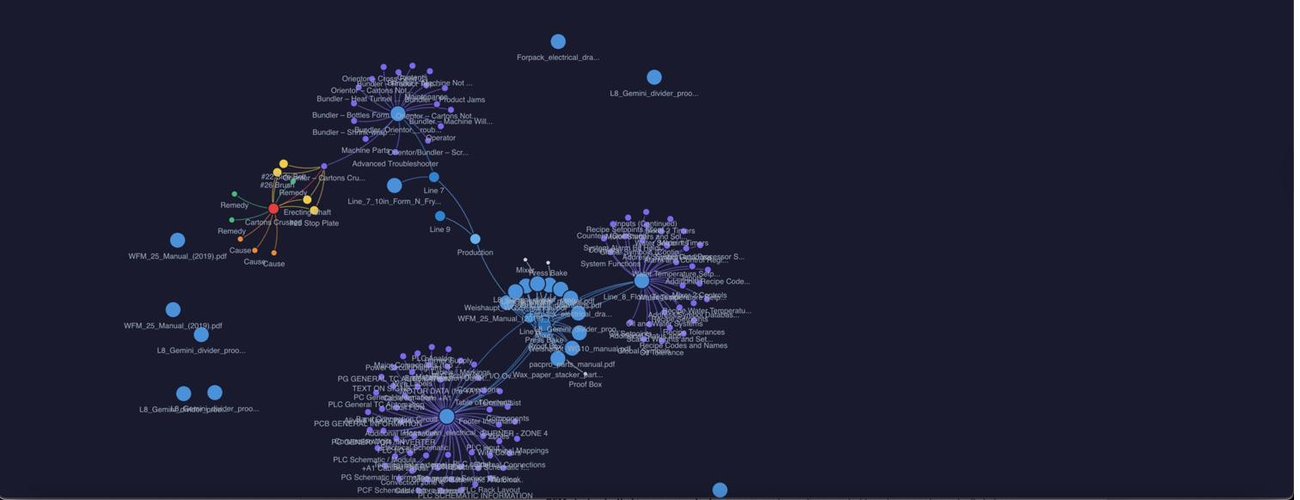
live knowledge graph · defects → remedies → parts → procedures
Knowledge graph
Connect anything and everything from your plants.
Structured signals and unstructured documents land in one graph, tied to the assets that generate them. Every node is a real document, defect, part, procedure or parameter. Every edge is a link your plant couldn't see before.
Signals, manuals, batch records, SOPs, defect and remedy history — in one place
Each plant's graph is isolated and individualized to that plant
It grows with every deployment — each new link makes the next answer faster
Live detection & guided fixes
See it forming, not after the line stops.
EQ-Seer watches live output against the profile of a good run and surfaces equipment and process deviations before they turn into scrap or downtime. When something breaks, the likely cause shows up next to the fixes that have worked on that exact asset.
Equipment and process deviations, flagged early with the readings behind them
Likely cause ranked next to fixes that worked before on the same asset
Read-only by default — EQ-Seer never writes back to your control systems
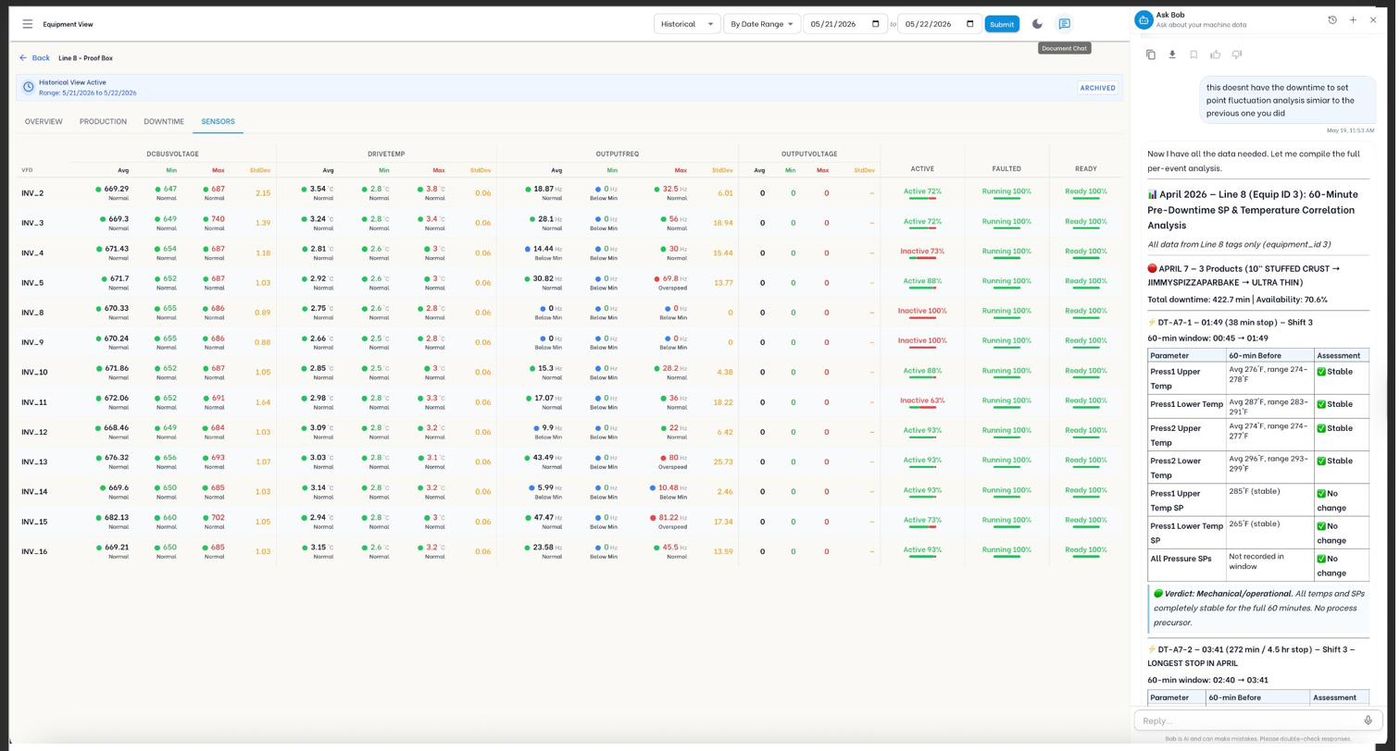
equipment view · sensors — historical range
Ask Bob
"Line 8 keeps stopping on the proof box — what's caused it before?"
Three past stops trace to drive-temp drift on INV_5. Two were cleared by reseating the sensor lead — both marked as worked.
Tribal knowledge capture
Capture the fix in whatever form is fastest.
At the machine, a tech records what they did the way that's quickest: a voice memo, a short video, a photo, or a note. EQ-Seer files it to the asset and symptom and marks whether it actually worked. Ask Bob in plain language and get the answer back, sourced from your own plant.
Voice, video, photo or text — captured where the work happens
It isn't collecting what people said; it's collecting what helped
Ask in plain language; answers cite the record they came from
Integrations
Connect what you already run.
EQ-Seer reads from the systems on your floor. No rip-and-replace, read-only by default, and you can start on a single line.
Control & SCADA
OPC UA · OPC DA Modbus · EtherNet/IP MQTT · PLC & sensor tags
Historians
OSIsoft PI · Ignition AVEVA / Wonderware Time-series & batch data
Maintenance & ops
CMMS — Fiix, Maximo MES · MRP / ERP Work orders & assets
Quality & records
LIMS · batch records SOPs · P&IDs Manuals & PDFs
Where the value shows up
Fewer surprises. Faster fixes. Knowledge that stays.
0
system types feeding one graph
0
live watch on every connected asset
0
new sensors required — it reads the data you have
0
to start — scale as the graph compounds
We track it with you:scrap rateunplanned downtimeMTTRfirst-time-fix raterepeat failuresknowledge retention
Security & trust
Enterprise-ready from the first connection.
EQ-Seer is built to sit inside an OT environment without asking you to loosen it.
Read-only by default
EQ-Seer reads from your systems and never writes back to control.
Deployment your way
Cloud, private cloud, or on-prem / edge for restricted networks.
Your data stays yours
Full tenant isolation: each plant's knowledge graph is isolated and individualized to that plant, never pooled with another customer's.
Access control & audit
Role-based access, SSO / SAML, and an audit trail on every action.
SOC 2 Type II In progress
Our SOC 2 Type II examination is underway. Ask for our current security package and status.
See EQ-Seer on one of your own lines.
Bring a line and a problem you already know. We connect a slice of your data, agree on one number to move, and show you what the graph sees in a couple of weeks.